“Men work from sun to sun, but women’s work is never done.”- Meryl Streep’s reflection resonates deeply across societies because it mirrors the everyday reality of countless women. While men’s work is often recognized as formal labor with fixed hours and visible outcomes, women’s work continues endlessly through cooking, caregiving, cleaning, childcare, emotional support, and household management, often without recognition, wages, and taken for granted. Despite progress in education, employment, and women’s public participation, patriarchal norms continue to normalize unequal labor burdens and unequal power relations.
These inequalities do not remain confined to households, they also shape how people experience the climate crisis. Women and girls are among those disproportionately affected by climate change, not because they are inherently vulnerable, but because the existing overlapping systems of inequities exposed them to climate risks. Women’s high dependence on natural resources, unequal access to land and finance, restricted mobility, unpaid care responsibilities, and exclusion or tokenistic participation in decision-making processes increase their vulnerability and reduce their adaptive capacity. The climate crisis further intensify due to compounded impact of intersectional aspects of inequities such as age, sexual identity, ability, ethnicity, economic, geography, diseases, disaster, etc.
At the same time, climate impacts worsen existing gender inequalities, creating a dangerous cycle where inequality fuels vulnerability, and vulnerability deepens inequality. This growing crisis raises urgent questions of "gender justice"
Globally, gender has increasingly become a mandatory component in climate policies, development programmes, donor frameworks, and institutional reporting systems. However, a bitter truth remains in many cases, gender considerations are still treated as a compliance “tick-box” rather than a genuine commitment to justice and transformation.
Institutions often include gender consideration in proposals and reports without fundamentally addressing unequal power structures, access to resources, representation in decision-making, or accountability mechanisms. Hence, participation becomes symbolic rather than meaningful and inclusion becomes procedural rather than transformative.
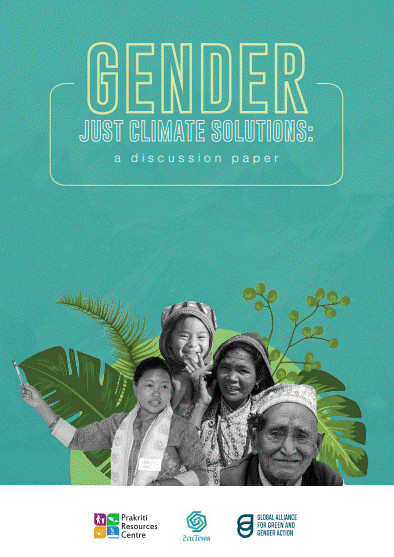
Recognizing this gap between commitment and accountability, Prakriti Resources Centre (PRC) and Tewa began exploring what genuine gender justice in climate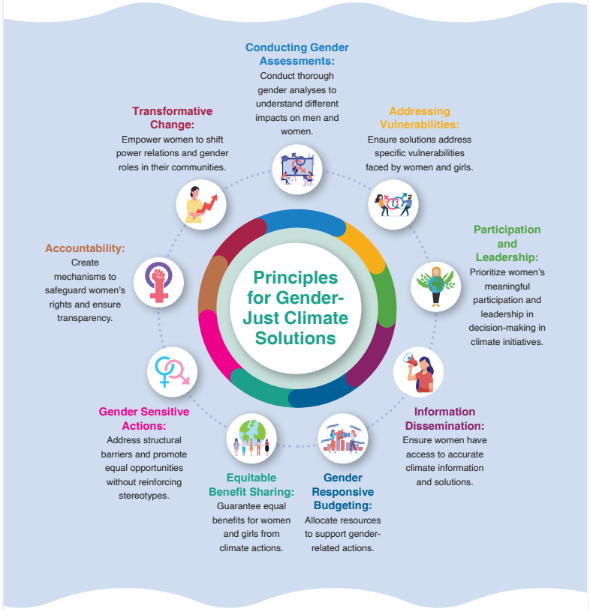 action should look like in practice. To address this challenge, PRC piloted a Gender-Just Climate Solutions (GJCS) approach through women's groups in five municipalities while simultaneously initiating a broader process to define, articulate, and measure gender justice in climate action. Grounded in Nepal’s realities and community experiences, this initiative sought to move beyond mere rhetoric and develop practical ways to assess whether climate actions are truly gender-just.
In 2022, the initiative identified nine key principles of Gender-Just Climate Solutions. However, principles alone are not enough, they must be measured.
Since then, PRC and Tewa have worked to unpack these principles through qualitative and quantitative indicators that can help measure whether gender justice is actually being achieved, rather than merely claimed.
This resulted in the publication of:
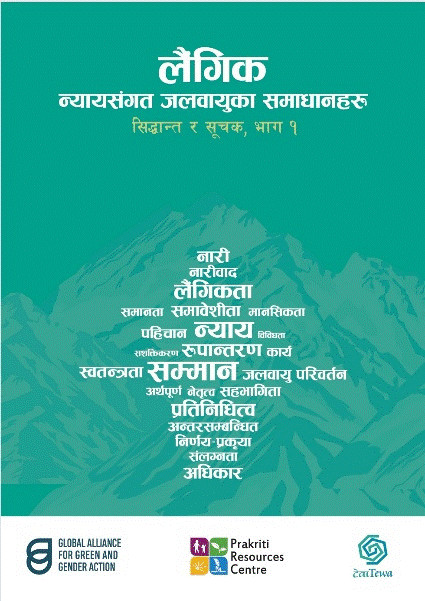
- Gender-Just Climate Solutions: Principles and Indicators, Volume-1
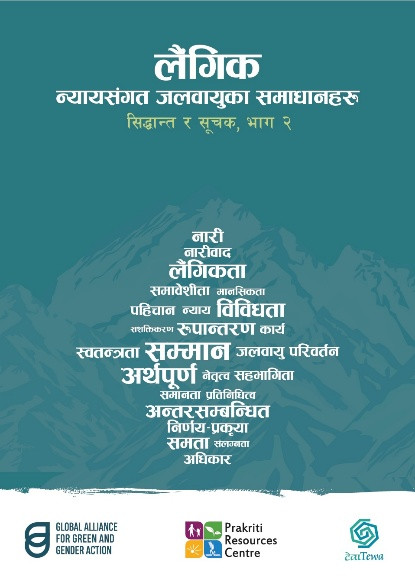
- Gender-Just Climate Solutions: Principles and Indicators, Volume-2
Together, these publications provide practical contexts and indicators that can support governments, development partners, climate finance institutions, civil society organizations, researchers, and community groups to:

Importantly, these indicators encourage institutions to ask difficult but necessary questions:
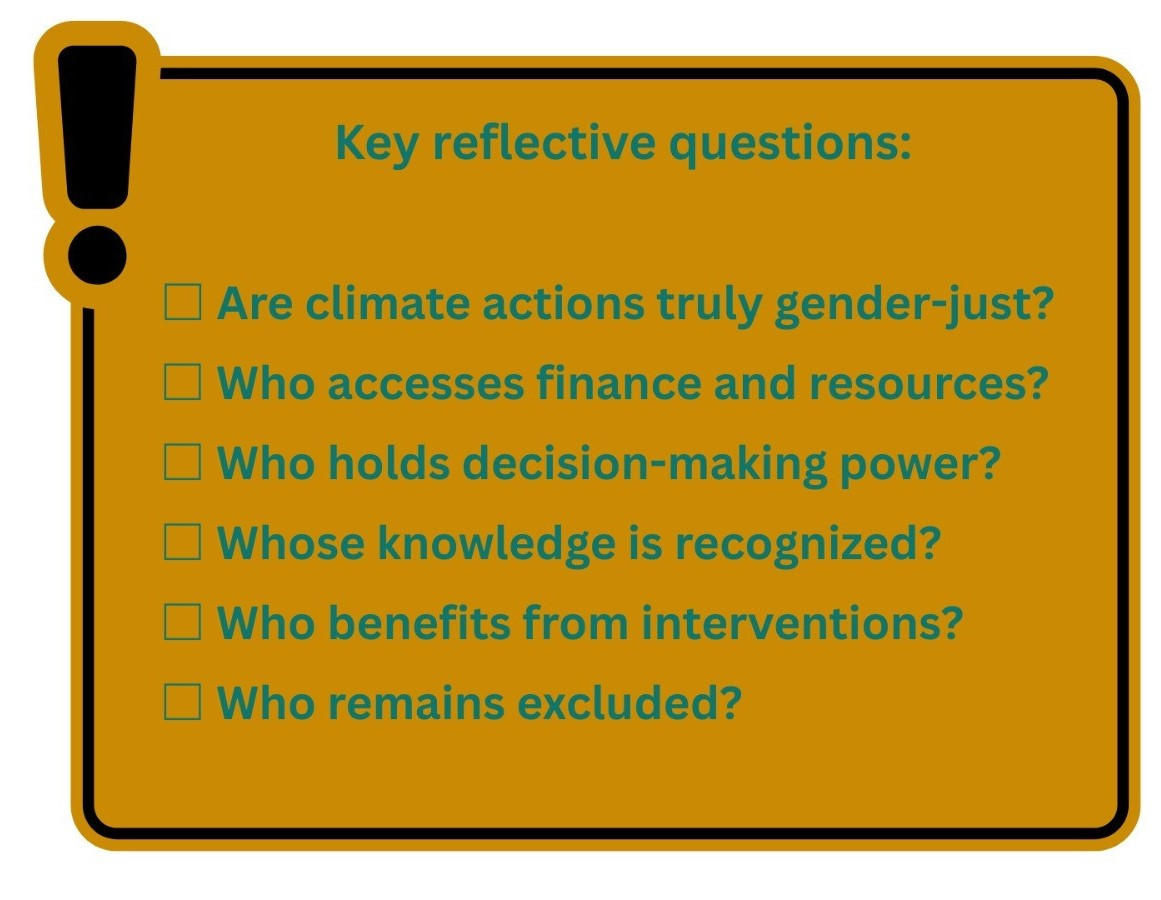
Although the research is rooted in Nepal’s context, the GJCS principles and indicators respond to a challenge faced globally: how to move from gender commitments on paper to measurable accountability in practice. As climate finance, adaptation programmes and locally-led climate action initiatives expand worldwide, institutions increasingly requires tools that can assess not only participation but also justice, equity and transformation. Thus, Nepal’s experiences with women-led local adaptation, Indigenous knowledge systems, community governance, and grassroots resilience offer important lessons for global climate discourse.
Climate action cannot be considered successful if it reproduces the same inequalities it seeks to address. Hence, Gender Justice is not an additional component of climate action. It is central to achieving sustainable, equitable, and transformative climate resilience.
As climate crises intensify across the world, institutions must move beyond performative inclusion and compliance-driven approaches. What is needed now is genuine institutional transformation, one that recognizes women, Indigenous Peoples, people with disability, LGBITQA and marginalized communities not as beneficiaries, but as leaders, knowledge holders, and decision-makers in shaping climate futures.
The question is no longer whether gender should be included in climate action. The real question remains on whether the institutions are prepared to ensure justice, accountability, and transformation beyond the tick box.
Gender-Just Climate Solution Series